
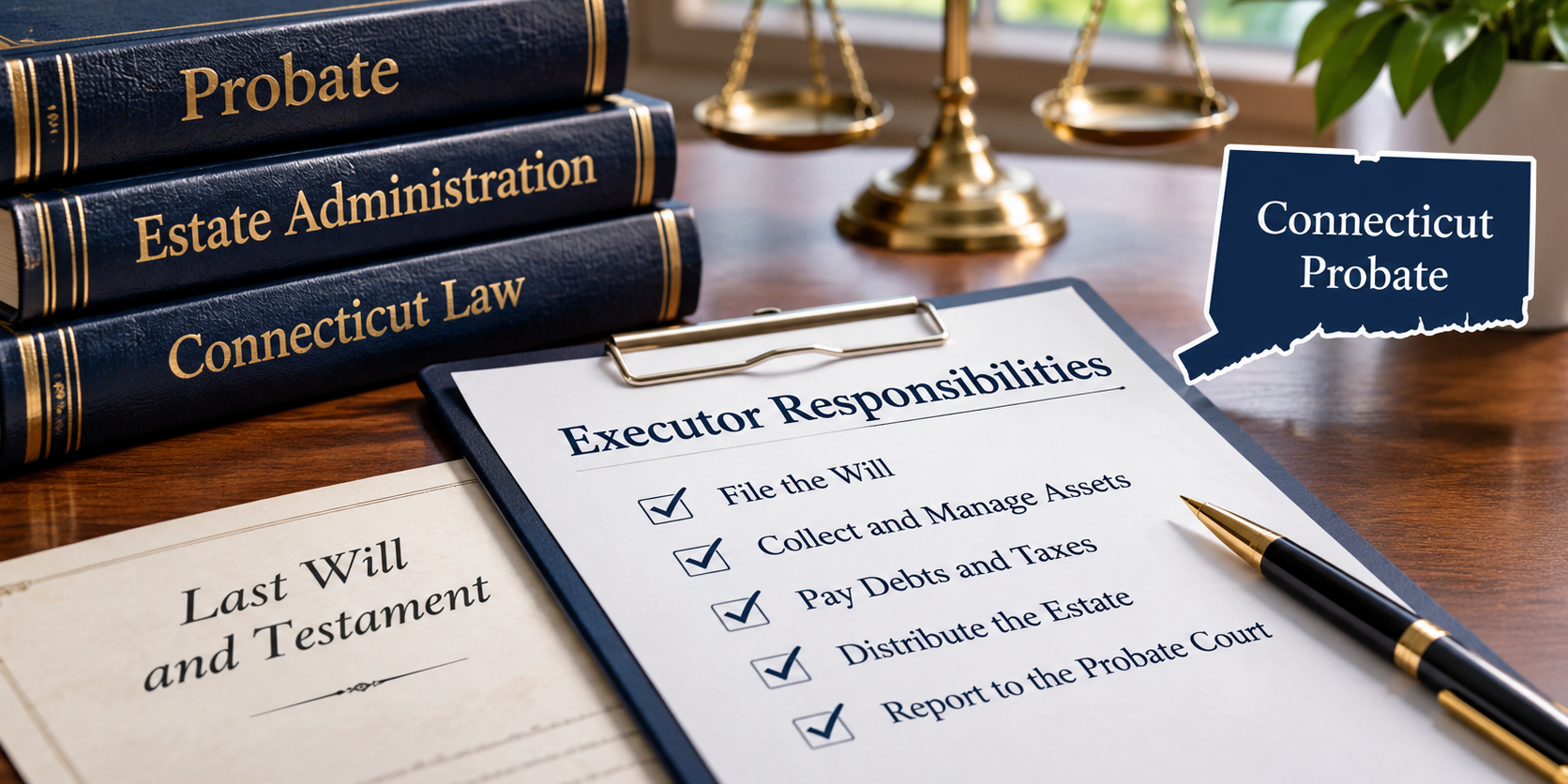
Executor responsibilities in Connecticut involve more than simply carrying out the instructions in someone’s will. Being named executor is an honor. It means the person trusted you to finish their affairs carefully and fairly. However, it is also a serious legal responsibility, with deadlines, paperwork, and potential personal liability if things go wrong.
In Connecticut, an executor is a fiduciary appointed by the Probate Court. A fiduciary must act in the best interests of the estate and its beneficiaries, not in their own interest. Although the will nominates you, your legal authority begins only when the court formally appoints you.
Many executors are grieving family members with no legal training. Therefore, understanding the role before taking action is important. This article explains what the job involves, step by step, and the mistakes that commonly arise during the Connecticut probate process.
What Are the Executor Responsibilities in Connecticut?
An executor’s job is to collect the deceased person’s assets, pay valid debts and taxes, and distribute what remains according to the will. Every estate is different, but most Connecticut estates follow the same general process.
1. Locate the Will and File It With the Probate Court
Connecticut law requires whoever holds the original will to deliver it to the Probate Court within 30 days after learning of the death. Generally, the court for the district where the deceased person lived handles the estate.
You can find information about probate procedures and required forms through the Connecticut Probate Courts.
2. Apply to Be Appointed Executor
Next, the nominated executor petitions the court to admit the will and approve the appointment. Interested parties receive notice, and the court may hold a hearing.
Additionally, the court may require a probate bond unless an applicable waiver or exception removes that requirement.
3. Obtain Your Fiduciary Certificate
Once appointed, the court issues a fiduciary certificate confirming your authority to act on behalf of the estate.
Banks, brokerage firms, and other financial institutions will generally request this certificate before releasing information or allowing access to estate assets.
4. Secure and Collect Estate Assets
The executor must safeguard the deceased person’s home, vehicles, personal belongings, and other property.
This responsibility also includes identifying financial accounts and collecting assets that belong to the probate estate.
In addition, you may need to obtain an estate tax identification number (EIN) and open a dedicated estate checking account. Estate funds should pass through that account, never your personal account.
5. Notify Creditors and Government Agencies
Connecticut has specific procedures for notifying creditors and reviewing claims against an estate.
Furthermore, the estate may owe money to the State of Connecticut for certain benefits the deceased person received, including Medicaid, commonly called Title 19.
Consequently, the executor must review valid claims and pay them in the proper order.
6. Prepare and File the Estate Inventory
An executor generally must file an inventory of probate assets with the court within two months of appointment, unless the court grants additional time.
The inventory lists the assets and their fair market value as of the date of death.
Accurate valuations are important because they help establish the estate’s financial position and support later accounting and tax filings.
7. Handle Estate Taxes and Tax Returns
Depending on the circumstances, an executor may need to prepare several tax returns, including:
- The deceased person’s final income tax returns.
- Estate fiduciary income tax returns.
- The Connecticut estate tax return.
- A federal estate tax return, when required.
Connecticut generally requires an estate tax filing even when the estate falls below the taxable threshold. Additionally, estate values help determine applicable probate fees.
For current filing requirements, visit the Connecticut Department of Revenue Services.
8. Pay Estate Expenses and Debts
Funeral costs, administration expenses, probate fees, taxes, and valid creditor claims must be addressed before beneficiaries receive their shares.
However, not all debts have the same priority. When an estate cannot pay everyone, Connecticut law establishes the order in which certain claims must be paid.
Therefore, executors should carefully review the estate’s obligations before making payments.
9. Distribute the Estate and Account to the Court
After resolving debts, taxes, and other obligations, the executor distributes the remaining assets to the beneficiaries named in the will.
The executor must also file the required final account or financial report with the Probate Court. Once the necessary filings are approved and administration is complete, the estate can be closed.
Not every asset passes through probate. Jointly owned property with survivorship rights, life insurance with named beneficiaries, retirement accounts, and assets held in trusts often pass directly to the intended recipients.
Nevertheless, the executor should know about these assets because they may affect estate taxes or certain creditor claims.
For additional information, read our article on how to avoid probate in Connecticut, which discusses strategies such as trusts and beneficiary designations.
Common Mistakes When Handling Executor Responsibilities in Connecticut
Most executor problems arise from good intentions and a lack of information, rather than bad faith. However, even innocent mistakes can cause delays, family disagreements, and financial liability.
The following are some of the most common mistakes executors should avoid.
1. Acting Before Being Appointed
Until the Probate Court appoints you, you generally have no legal authority to sell estate property, close accounts, or sign documents on behalf of the estate.
Taking reasonable steps to secure a home may be appropriate. However, selling the deceased person’s vehicle before receiving authority is another matter.
2. Mixing Estate Money With Your Own
Depositing estate funds into a personal account, even briefly, can violate your fiduciary duties.
Instead, use a dedicated estate account for all estate income and expenses. This also makes financial reporting easier.
3. Distributing Assets Too Early
Beneficiaries may want their inheritance as quickly as possible. Nevertheless, distributing assets before settling debts, taxes, and valid claims can create serious problems.
If the estate later lacks sufficient funds to meet its obligations, the executor may become personally responsible for improper distributions.
Therefore, wait until the estate’s financial obligations are clear.
4. Paying Debts in the Wrong Order
When an estate cannot pay all its creditors, Connecticut law establishes priorities for certain claims.
For example, paying an ordinary credit card debt before higher-priority expenses may create financial complications.
As a result, executors should understand the proper payment order before settling claims.
5. Missing Important Deadlines
Late inventories, tax returns, and court filings can result in penalties, interest, and unnecessary delays.
To avoid these problems, maintain a calendar from the beginning of the probate process. Additionally, keep copies of all documents submitted to the court.
6. Overlooking the State’s Claim
If the deceased person received Medicaid or certain other public benefits, the State of Connecticut may have a claim against the estate.
However, recovery depends on the benefits received and the applicable legal requirements.
Ignoring a potential state claim can delay closing the estate and create additional liability.
7. Poor Recordkeeping
Executors must account for the estate’s financial transactions.
Therefore, keep receipts, bank statements, invoices, and records of every payment or distribution.
Also, document important decisions, including how property was valued or why an asset was sold.
Good records can help protect you if a beneficiary questions how the estate was managed.
8. Favoring One Beneficiary or Yourself
Executors who are also beneficiaries must be especially careful to avoid conflicts of interest.
For example, buying estate property at a discount, using the deceased person’s home rent-free, or allowing one sibling to take belongings early can lead to objections and disputes.
Above all, executors must follow the will and fulfill their fiduciary obligations fairly.
9. Failing to Communicate With Beneficiaries
Beneficiaries who hear nothing for months may become frustrated or suspicious.
However, regular updates can help prevent misunderstandings and family conflicts.
Explain what has been completed, what remains outstanding, and why certain steps may take longer than expected.
10. Trying to Do Everything Alone
Probate involves legal, tax, and financial questions, sometimes all at once.
Although executors can handle certain tasks independently, complicated estates may require professional assistance.
In many cases, preventing a mistake is far easier and less expensive than correcting one.
Do You Need an Attorney for Executor Responsibilities in Connecticut?
Connecticut does not generally require an executor to hire an attorney. In fact, some small and straightforward estates can be handled without legal representation.
However, an experienced probate attorney can help you understand your legal obligations, meet deadlines, and reduce the risk of personal liability.
Legal guidance may be particularly valuable when an estate involves substantial debts, tax issues, real estate, or disagreements among beneficiaries.
Furthermore, an attorney can help you understand how probate administration relates to broader estate planning matters, including wills and trusts.
If you are uncertain about the probate process or how long it may take, you can also explore our article on how long probate takes in Connecticut.
How Farrell & Grochowski Can Help Executors in Connecticut
Serving as an executor can feel overwhelming, especially when you are grieving the loss of a loved one.
At Farrell & Grochowski, we guide executors through the Connecticut probate process. Our law firm, located in Wallingford, Connecticut, assists families with probate, estate administration, wills, trusts, and related legal matters.
Whether you have just been named executor or are already partway through the process, we can help you understand your duties and carry them out with confidence.
Our goal is to help you fulfill your responsibilities while avoiding unnecessary delays, costly mistakes, and potential disputes.
If you have been named executor of an estate, contact Farrell & Grochowski to schedule a consultation. Our attorneys can help you navigate the probate process and protect your interests while carrying out your loved one’s wishes.
Disclaimer
This article is provided by Farrell & Grochowski for general informational purposes only and does not constitute legal advice or establish an attorney-client relationship. Every estate is different, and Connecticut probate laws and procedures may change. Please consult a qualified attorney regarding your specific circumstances.